For updates or questions
Email us at info@wearemosaicchurch.org.

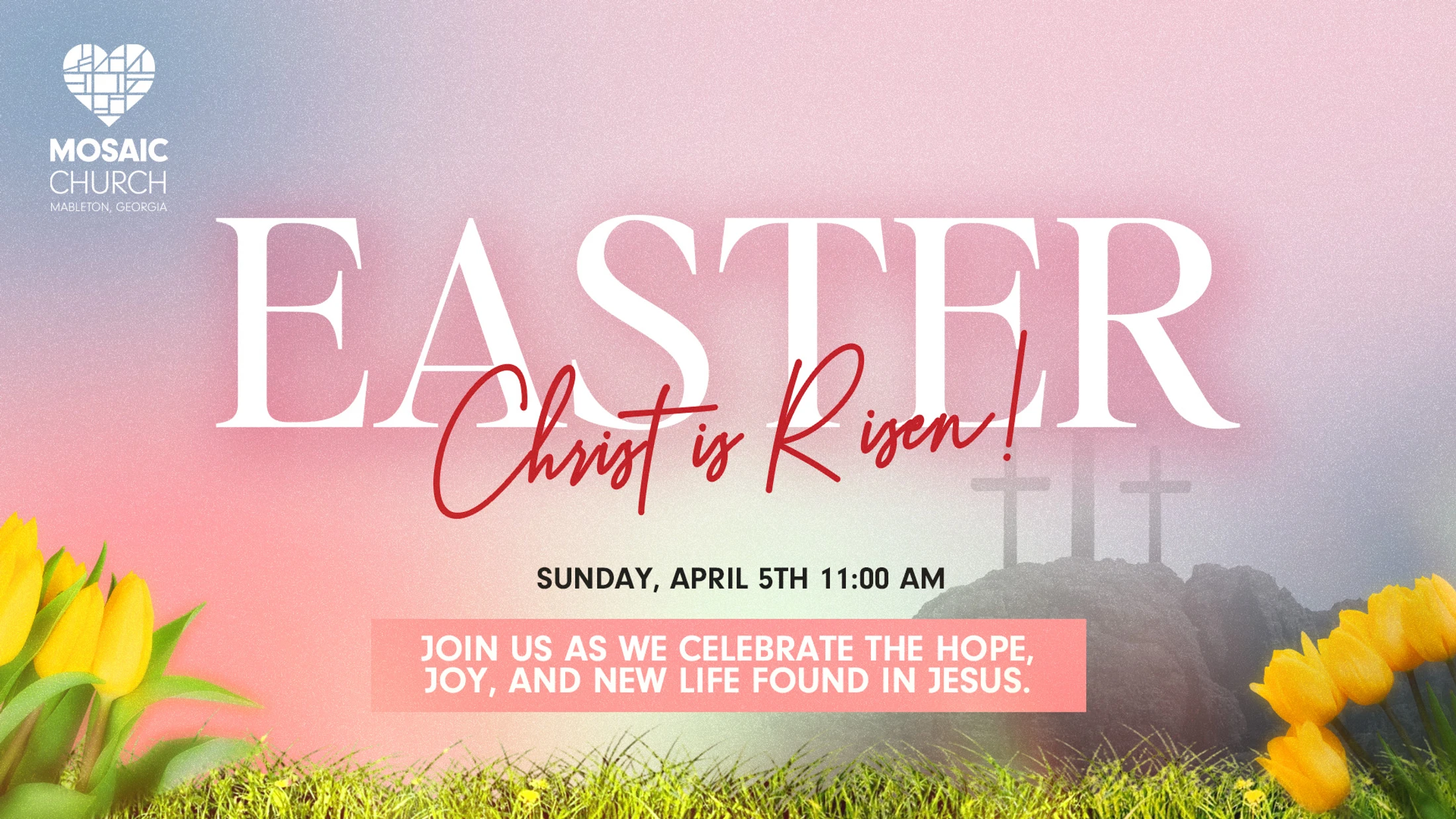
Celebrate with us! Easter Sunday, April 5
Let's start with something real.
Most of us are carrying something we wish we could put down. A conversation that went sideways and never got fixed. A version of ourselves we're not proud of. A relationship that broke and stayed broken. Something we did — or something that was done to us — that still lives rent-free in our heads years later.
And then Easter shows up. Every single year. Right on time.
Easter is the biggest day in the Christian calendar. Bigger than Christmas — and yes, I know that might surprise you, because Christmas has the music and the movies and the whole cultural moment. But Christmas is the beginning of the story. Easter is the point of it. Easter is the day the whole thing either means something or it doesn't.
So this week, with Easter Sunday coming up on April 5, we want to talk about what Easter actually has to do with your life. Not just the religious version of it — the real version. The one that speaks to the exact thing you've been carrying.
What Easter Is Actually About
Here's the short version: Jesus died on a Friday. His followers were devastated. They thought it was over. And then Sunday came, and the tomb was empty.
That's it. That's Easter.
But the why behind it — that's where it gets personal.
The Christian claim is that Jesus didn't just rise from the dead as a miracle for its own sake. He rose because death, shame, guilt, and everything that separates us from God and from each other had been defeated. He absorbed the full weight of all of it — every wrong thing ever done, every broken relationship, every moment someone said "I can't come back from this" — and He walked out of the grave anyway.
Easter is God saying: nothing is beyond this.
That's a big claim. We know. But if it's true — and we believe it is — then it changes everything about how we think about forgiveness.
The Thing Nobody Tells You About Forgiveness
Here's what most people think forgiveness means: you have to feel okay about what happened. You have to act like it didn't hurt. You have to let the person who hurt you back into your life like nothing occurred.
That's not what forgiveness is.
The word for forgiveness in the original Greek of the New Testament is aphiemi. It means "to let go." To release. To send the debt away. Forgiveness is not pretending the harm didn't happen. It's deciding that you are not going to let it keep running your life.
It's not something you do for the other person. It's something you do for yourself.
And here's what makes Easter relevant to all of this: the forgiveness God offers through Jesus is that kind of forgiveness. Not a cosmic cover-up. Not God pretending your stuff didn't happen. He sees all of it — every version of you, every mistake, every moment you're ashamed of — and He says, I'm releasing the debt anyway. I'm not holding this over you.
That's the Easter offer. And it's not something you earn. You don't get it by being good enough or trying hard enough or having your life together enough. You get it because Jesus already paid for it on the cross and walked out of the grave to prove it worked.
You Don't Have to Have It Together to Come
We need to say this clearly, because a lot of people have complicated feelings about church.
Maybe you grew up in church and got hurt. Maybe you believe in God but you're not sure what you believe about Jesus. Maybe you've been away from faith for a while and you're not sure if you're "allowed" to come back. Maybe someone told you that you had to be a certain way to belong.
None of that is true here. Easter is for everyone — specifically for the people who feel like they're on the outside of it. That's actually who Jesus kept showing up for.
In John 8, the religious leaders dragged a woman into a public space and made her the subject of everyone's judgment. Jesus looked at the crowd and said: let whoever is without sin throw the first stone. One by one, they left. And then Jesus turned to her — just her — and said: I don't condemn you.
He didn't say "get your act together and then come back." He said it right there, in the mess, before anything had changed.
That's the posture Easter is built on. You don't have to clean yourself up first. You come as you are.
What If You Need to Forgive Someone?
Maybe you're not the one who needs to receive forgiveness right now. Maybe you're the one who has been hurt, and someone has been telling you that you have to forgive — and the idea makes you feel sick because you know what that person did.
Here's what we want you to hear: forgiving someone does not mean staying close to them. It does not mean pretending what they did was okay. It does not mean you owe them a relationship.
Forgiveness is an internal act. You can forgive someone completely and still choose not to be in their life. Those are two separate things. One is for your healing. The other is a decision about your safety and your relationships — and that belongs to you.
The resurrection of Jesus doesn't erase what happened. It offers a way to carry it differently. Joseph in Genesis spent years processing the fact that his own brothers sold him into slavery. He didn't rush to reconcile. He cried privately, multiple times. He waited to see whether they had actually changed. And when they finally came together again, it was real — because it was honest.
Easter gives you permission to forgive without it being cheap. To release without having to pretend. To move forward without being forced.
What We're Doing This Sunday
We would love to have you with us this Easter Sunday, April 5, at 11am at Mosaic Church.
Here's what you can expect: a service that's genuinely celebratory, because this is the day we've been building toward all season. Music that will move you. A message that will meet you where you are. And a room full of people who are also figuring this out — no performance required.
One special heads up: We're doing Easter family photos before service, and the line after service is always long. If you want a photo without the wait, come early. We'll have everything set up and ready before 11am, so you can get your moment, grab a seat, and be ready for a service that's worth showing up for.
Bring your family. Bring your questions. Bring the friend who's been on the edge of something and just needs one more invitation.
One More Thing
There's a quote we've been sitting with this week. Lewis Smedes, one of the great writers on forgiveness, said it this way:
"To forgive is to set a prisoner free and discover that the prisoner was you."
That's what Easter is offering. Not a list of things to fix. Not a standard to meet before you're allowed in. Just an open door, an empty grave, and an invitation to put down what you've been carrying longer than you should have.
We'll see you Sunday. Come early. Come as you are. Come ready — because Easter is a big deal, and we don't want you to miss it.
Sunday, April 5 · 11am · Mosaic Church Come early for family photos before service — beat the post-service line.
Questions? Want to know more before you come? Reach out to us. We mean it when we say no question is too small and no story is too messy. That's kind of the whole point.